Showing posts with label round. Show all posts

09 January 2013

Words of Smoking Writers : Chomsky, Crumb, et al...


Either you repeat the same conventional doctrines everybody is saying, or else you say somthing true, and it will sound like it's from Neptune.


-Noam Chomsky
What the hell is this?? Who can tell me?? Does anybody know?? How can I find out more about it?? One thing's sure: the human mind can't "know" it...why does one want to "know"??
-Robert Crumb

Three o'clock is always too late or too early for anything you want to do.
-Jean Paul Sartre
There is a way to master silence
Control its curves, inhabit its dark corners
And listen to the hiss of time outside
-Paul Bowles

A woman's guess is much more accurate than a man's certainty.
-Rudyard Kipling

13 September 2012

Strange Unveiling : What is Calvin Johnson?

Calvin Johnson with Heather Lewis and Brett Lunsford of Beat Happening, 1985.


11 September 2012

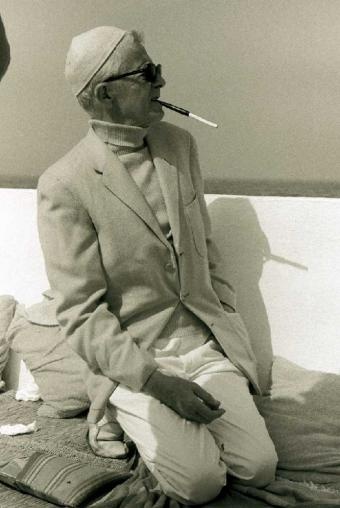
Mondrian's Glasses and Pipe : Paris, 1926

By André Kertész
View the André Kertész collection at the National Gallery of Art

22 August 2012

HDV Likes : Bill Mount's Opera Glasses

HDV patron Bill Mount wearing Francois Pinton at the Beijing Opera

05 April 2012

07 March 2012

East to West : American Painter Yasuo Kuniyoshi

America or military school was the course I had set my heart on when a boy of thirteen. My parents did not approve of my choice, but beeing a spoiled only child, I aimed for the stars, not really expecting to have them. Father thought I was too young to live alone far from home, and the military school held no appeal for him since the Russo-Japanese war was then in progress.

Nevertheless, and much to my surprise, he finally gave his consent to my coming to America all alone. I thought of all the exotic and wonderful things I would see, and when the time came to go I left without sentimentalities or tears and with a brave adventurous spirit.
I had no definite plans when I arrived on the West Coast in September 1906, a vague idea that I should like to stay two or three years, learn to speak English fluently and be able to translate English into Japanese. Then all polished, return home.

My dream of America and actually seeing America were two totally different things. I thought nothing of money, expecting to pick it up practically from the streets.
Unable to speak but a few monosylables in English, with no friends or any experience it was far from easy at first. I realized more than anything that I had to earn a living before I could go to school to learn English. I got a job working in a railroad in Spokane, through the good services of the hotel manager at a Japanese hotel where I was staying in Seattle.
After two days of sweeping out the round house, carrying buckets of water and sleeping on the wooden bunk without any mattress I went scuttling back to Seattle. This was my first real smack of America and it left me shattered, I began to long for home, but I had been so brave when I first landed here, that I had sent all the money I had back to father and told him that I was in a country where there was lots of money and so I didn't need it. I was stranded and so blue. I would have gone back if I had any funds after being here for only a month.
I've never forgotten the feeling of sitting day in day out in the harbor watching the big boats go by and eating peanuts. It was the first taste of peanuts I had in this country, and I've never eaten them since.

-Excerpt from "East to West" by Yasuo Kuniyoshi, published in the Magazine of Art (February 1940)
.

Yasuo Kuniyoshi was born in 1893 in Okayama, Japan. At the age of thirteen he came to the United States and a year later began studying at the Los Angeles School of Art and Design. In 1910 he moved to New York and took courses at the National Academy of Design, the Independent School of Art, and the Art Students League, where he studied with Kenneth Hayes Miller. He was married to fellow artist, Katherine Schmidt from 1919 to 1932, and after traveling throughout Europe, they moved to the Woodstock, New York in 1927 and took part in the Woodstock Art Colony.

Kuniyoshi studied and later taught at the Art Students League summer school there. By 1930, he had established himself as an internationally known painter and graphic artist. In New York City he taught at the Art Students League, the New School for Social Research, and served as the first president of the Artists' Equity Association from 1947 to 1950. Kuniyoshi was active in social organizations, especially Japanese American organizations, such as the Japanese American Committee for Democracy, and took an active role in the war effort during World War II. Yasuo Kuniyoshi died in 1953 and was survived by his second wife Sara Mazo who preserved the legacy of his work.

View the Yasuo Kuniyoshi papers at the Archives of American Art
Visit the Yasuo Kuniyoshi Museum in Okayama

Portrait of Yasuo Kuniyoshi in his studio by Bumpei Usui, 1930.


27 December 2011

Dolly Dolly

Sex-Happy / Hash-Hippy / Ultra Cool

18 October 2011

Occupied Paris

Parisians under wartime occupation (1941-1944) by Andre Zucca

07 February 2011

Zohma & Jean Charlot | 1933

Zohma & Jean Charlot, photographed by Edward Weston, 1933.

Portrait of Jean Charlot by Henrietta Shore, 1927 on view at LACMA.

Although Jean Charlot was born in Paris and descended from parents he later described as “sundry exotic ancestors” – his father, a French businessman reared in Russia, and his mother, with her French, Mexican and Jewish lineage – Charlot was drawn to the Mexican part of his heritage. From the age of two, he was surrounded by pre-Hispanic antiquities.

He studied in the Ecole des Beaux-Arts, exhibited in the Autumn Salon, and made the usual training tour of Brittany. In 1920, his mother introduced him to Mexico where he sketched for archeologists excavating Mayan ruins. In 1922, after fighting in the First World War he decided to move to Mexico. He shared a studio with the painter Fernando Leal and became involved in the booming artistic scene promoting wood engraving and lithographic techniques.

He quickly established himself in the art community of Mexico City and befriended Diego Rivera, David Alfaro Siqueiros, and Jose Clemente Orozco, main figures in the Mexican Mural movement of the early twenties known as the Syndicate of Painters and Sculptors. The movement quickly spread to the USA. Charlot is credited by Rivera for reviving and refining the art of true frescoes.

Read the full biography here (Courtesy of the Isaacs Art Center)

Inspiration, Study, Creativity
Fresco, 1967

28 July 2009

Portrait of the Artist in a Hollywood Spanish Interior | David Hockney by Peter Blake, 1965

Portrait of David Hockney in a Hollywood Spanish Interior, Peter Blake, 1965.
Courtesy of the Tate Collection

During the late 1950s, Sir Peter Blake became one of the best known British pop artists. His paintings from this time included imagery from advertisements, music hall entertainment, and wrestlers, often including collaged elements. It was with the 'Young Contemporaries' exhibition of 1961 where he was exhibited alongside David Hockney that he was first identified with the emerging British Pop Art movement.

Portrait of David Hockney in a Hollywood Spanish Interior is based on a photo by Michael Cooper (a prominent 1960s photographer), showing David Hockney standing in front of another Cooper photograph called Spanish Interior. This is presumably the source of Blake’s title; the setting is a Hollywood party. Cooper is best known for his photos of the Rolling Stones. He also collaborated with Blake on the cover for the Beatles’ album Sgt Pepper’s Lonely Hearts Club Band.

According to Blake, the original concept was to create a scene that showed the Sgt. Pepper band performing in a park; this gradually evolved into its final form, which shows the Beatles, as the Sgt. Pepper band, surrounded by a large group of their heroes, rendered as lifesized cut-out figures.

Also included were wax-work figures of the Beatles as they appeared in the early '60s, borrowed from Madame Tussauds.
The wax figures appear to be looking down on the word "Beatles" spelled out in flowers as if it were a grave, and it has been speculated that this symbolises that the innocent mop-tops of yesteryear were now dead and gone.

17 July 2009

Destruction of the Old Order | Orozco in Rounds

Mexican painter José Clemente Orozco, circa 1930.

Self-Portrait. 1940. Courtesy of MoMA.

08 July 2009

Tokyo Joe | Fur Hat & Spectacles of '47

Japanese labor leader Komakichi Matsuoka wearing fur hat and glasses in Tokyo, Japan. Photographed by John Florea.

24 June 2009

18 June 2009

Otto Preminger | Hollywood, 1959

Director Otto Preminger on the set of the motion picture Porgy and Bess.

15 May 2009

"I am not a myth" | Marlene Dietrich, 1938

Actress Marlene Dietrich eating at the Paramount commissary, wearing sunglasses. Photographed by Alfred Eisenstaedt.

16 April 2009

Young Scientist in Black Horn Rounds Circa 1920

Scientific experiments at the California Institute of Technology in the late 1920s and early 1930s. This view shows a man looking into an eyepiece connected to a small white cylinder.